

How To Say A Man In Spanish
+
Acera
its literal translation to English language is pavement (United kingdom of great britain and northern ireland) or sidewalk (US). Although in most cases it appears as the idiom "es de la acera de enfrente" (is from the opposite sidewalk), in several dictionaries as the Martin and Leon, it appears as a term to point to homosexual or effeminate homo. "Es de la acera de enfrente" is related to the pathologizing idea of sexual inversion, which has produced terms as "Invertido" and "Invertito" in the Spanish and Italian language, or "Konträr" in German language linguistic communication, meaning Invested.
In the English language nosotros find the aforementioned meaning with expressions like "bat for the other team", "play for the other team" and "for the other team".
Related Invertido.
+
Afeminado
term used to refer to a man with a feminine gender expression in one or several of its characteristics, either when speaking, when moving, when dressing, ect. The effeminacy in men does not necessarily imply homosexuality, still the expression has been used every bit a euphemism for homosexual human being, as an insult against homosexual men or who could be homosexual, and to criticize the lack of manhood. Afeminado is one of the terms that shows that behind the homophobia is the machismo, since it expresses how negative it is to be like a woman, or show some of its characteristics. The first record of the term Afeminado dates from the 15th century, however the label or stereotype of the effeminate is much earlier, from at least the 4th century BC. when sex with men did not imply effeminacy, every bit long as the agile part was adopted. The masculine and the feminine are categories that change and are exchanged with time and societies, however the feminine is ever considered negative or of second order, dought much of those feminine characteristics have been masculine in another epoch.
Synonyms Adamado, Ahembrado, Amadamado (del francés "madam"), Amanerado, Amujerado, Cuasihembra, Femenino, Medio mujer, Medio hembra, Mujerado, Mujercísima, Mujercita, Mujeríl, Mujerona.
+
Afrancesado
its translation into English language is frenchified. The term appears in Spain from Independence War to name castilian people who supported Napoleon, probably refering that french people were effeminate by the dress they were wearing at the fourth dimension. Also it is quite common worldwide express that homosexuality comes from outside. Today the term is used in Argentina and ways effeminate homo and faggot.
+
Amanerado
its literal translation to English is mannered. Term for a human who shows manner or/and gait of woman. Is euphemism for effeminate human being that can also advise homosexuality.
+
Amapolo
term used to refer to the homosexual man both in Espana and in Latin America. Although information technology is not a well-known word and in principle it seemed a localism (since it seems to exist used by the heterosexual men in Andalusia to refer to a homosexual in the cupboard), the first reference was plant in the 50s in United mexican states, in the 70s in Colombia and in Spain in the 80s.The utilise of flower names as a euphemism or every bit an insult is also establish in other languages such as English, with terms similar Daisy, Pansy and Buttercup, whereas in Spain the apply of generic word "flor" (flower) and its variations is more frequent to signal homosexuals. You tin also observe amapolo with the meaning of transvestite.
Variations Amapola.
+
Ambidextro
ambidextrous. Though it ways a person who uses equally the right hand and the left, is also used to refer to bisexuals. We find the aforementioned pregnant in Italian language with the word Ambidestro.
+
Ambiente
the word "ambiente" translated into English is scene, and in Spain is a euphemism for gay scene. To be from scene is to be gay, and go out at scene means go out at gay zone.
+
Argolla
ring. Word used in Venezuela to refer to gay or effeminate man, probably related to the fact that there they name "Argolla" to hoop earrings, which are often associated with women.
+
Barbilindo
physical features, controlled past gender vigilance, are also a source of terms used against homosexual or effeminate men. So the absence in the adult homo of virile features similar hard factions or absence of facial or body hair, is associated with femininity and childhood, that is, lack of manliness. The word Barbilindo is, composed by two parts Barbi + lindo. "Barbi-" comes from barba (beard) and "-lindo" translated into English is pretty. So, the give-and-take Barbilindo relates the masculine beard with the adjective pretty, normally used with women. The mixture of these ideas suggests homosexuality or effeminacy.
Related Barbilucio (from Barbilindo), Aniñado (artless), Garzón (from French Garçon, meaning child, boy, etc).
+
Bardaje
Bardaje means passive homosexual man (bottom in anal intercourse), or as DRAE says, the patient sodomite. The term comes from the Arabic term Bardag, meaning slave boy, which in plough comes from the Persian expression Hardah, meaning slave. Go on in listen that in the Roman Empire the Greek homosexual construction system, teacher-educatee, became in the master-slave organization, which socially allows men sodomize his slaves, and generally, homosexual behavior whenever it was agile (meridian in anal intercourse). In ancient times it could as well mean prostitute. Slavery, prostitution, babyhood, and homosexuality united in a word. It has its equivalent in the Italian language with the term Bardassa and in the Valencian language with Bardaix.
Variations Bardaja, Bardajo, Bardajismo (transvestism), Berdaje.
+
Brisco
Uruguay term used to refer to homosexual man. In that location are two possible explanations for the origin of the slang, on the i hand there are those who say that comes from the fruit brisco peach or apricot, which is very easy to open, related to the alleged ease with which gay men put their butts to exist fucked. On the other side Brisco would exist synonymous for confused, incorrect, dizzy, lost, etc, characteristics socially attributed to gay men. This latter is what seems most likely explanation for the slang, as this same process is repeated in many other words, such as Pato.
+
Bufo
in Martin's dictionary appears as slang for passive (bottom) homosexual man. Although mostly it applies to the comic, grotesque, absurd, funny, etc., it relates to homosexuality past the issue we discussed in the term Maricón, about the stereotype of sissy, an effeminate man, harmless and with which make fun at his expense.
See Maricón.
+
Bujarrón
Bugger. The word derives from Bulgarian gentilic . The origin of the term dates back to the ninth century, when Orthodox Catholics wanted to evangelize Bulgarian territory, where at that place was a very strong animist stream. To combat this they spread the idea that in the area of Republic of bulgaria was a sect that expert sodomy. Derogatory intention.
Variations Bujarra, Bugarrón (Cuba, Miami, Rep. Dominicana and Puerto Rico. Sometimes equally a synonym for hustler.)
+
Buses
recent term coined in Peru belonging to the LGBT slang, to refer to a kind of gay that a sure sector considers "more modern", discreet, masculine, who tin be active (tiptop) in anal intercourse, as opposed to the feminine homosexual, transvestite, bordering transsexuality, always passive (bottom) in sex, crazy, and probably looking for mostaceros. They are the buses gays and also used referring to the buses scene.
Tracing the origin of this expression nosotros have met with a gruesome story, quite common unfortunately, focused on internalized homophobia and sexual desire.
The give-and-take Buses derives from the surname Busses, of a young male and spoilt brat, who lived in the 80s in Lima. Homophobic and probably with sexual conflicts had fondness for walking by the famous Kenedy Park, place chosen for cruising and lubricious deals for faggots, transvestites and hustlers of the Peruvian majuscule. Dressed for the occasion the young Busses becomes a muscular and manly claim, posing as male person prostitute. When he was sure that was hooked up with a gay man, he beat him up till most killing. The story goes that he ran out the fun when a group of transvestites gave hunt to him and severely beaten.
It was non known more of that guy, only over time it began to use the term "Buses chola" past alerting each other that some homophobic people was coming closer and that, therefore, they should act with discretion to avoid bug. From here, in that location was a semantic leap by which the discussion Buses was used to refer to a type of gay men, more discreet, more masculine, and more than mod, which we referred at the beginning.
+
Cabro
Homosexual man. Used in Peru, Bolivia, Rep. Dominicana, Puerto Rico and Republic of chile. The get-go reference we have found in a study of 1910 about the Coa, the Chilean jargon of delinquents, in which the term Cabro appears with the significant of sodomite and the term Cabrito (diminutive of cabro) every bit passive Uranian nether 18. We accept too found relationship betwixt Cabro and female prostitution, as in other occasions the female prostitution has been the source of many terms and expressions against gay men.
2
Cacorro
term for gay men used in Ecuador. Also used in Colombia and Venezuela, only to point to homosexual men with active (pinnacle) role in anal intercourse. Equally for the origin of this expression it may be related to "caca" meaning poop in Spanish language. Another origin may exist the significant it has in Mexico, where it is used as synonym for idiot, airheaded, etc., negative characteristics of men, attributed to homosexuals past the mere fact of been homosexuals.
Variations Cacoman (Venezuela).
+
Canco
the discussion Canco appears in the poem by Federico García Lorca "Oda a Walt Whitman" catastrophe with a serial of words, or rather insults, we supposed used to bespeak gay men of the time: "Faeries de Norteamérica, pájaros de la Habana, jotos de Méjico, sarasas de Cádiz, apios de Sevilla, cancos de Madrid, floras de Alicante, adelaidas de Portugal".
Previously we plant the term in a text by Pío Baroja, a writer with an interesting biography, of the previous Generation of '98. In one of the 8 volumes that etch "Desde la última vuelta del camino" entitled "Concluding de siglo XIX y principios del XX", there is a chat between two characters in the book, the word Canco is used, although of the context can not be deduced exactly its pregnant. Scholars of the work of Pío Baroja say that the meaning of Canco in this text is stupid, gullible, etc.
Years after, in the poem of Lorca, information technology appears as a synonym for faggot. So, the term Canco would be another example in which there has been a semantic leap of the negative characteristics of some men to gay men, past the mere fact of beingness, as it has happened with other words such as Palomo and Pato.
+
Caraoquero
term for gay men used in Bolivia, probably related to karaoke bars, but nosotros do not know if information technology is related with homosexuality for being a less masculine activity for a particular sector of the land, or for the karaoke bars type of audience in Republic of bolivia, full of gay people.
+
Carroza
its literal translation is carriage. Term used in the 70s and 80s in Spain actualization in several dictionaries of slang of the fourth dimension. Into one appears as just homosexual homo, in another as old homosexual man, but in others, every bit in Cela or Cardin dictionaries, it appears as a middle-anile gay man with money. Information technology seems the term is associated with another gay slang term, well known, which is Chapero, derived from Chapista, with slang meaning of hustler, and with the literally meaning of person who works with metal sheets, a panel beater.
According to the DRAE, Carroza, in add-on to the vehicle, means atomic number 26 frame, and it is with this sense where the Chapero comes into play since he is working with the metal sail of the iron frame. The Chapero works with the Carroza, or said of another way, the Chapero is making sex for money.
The term carroza is also used to refer to a old or outdated person without having any sexual connotation, but we do not know which of two slang was the start and the origin.
Related Portaviones (aircraft carrier, bigger than carriage, a height for Carroza), Chapero (huster).
+
Cáscara amarga
its literal translation to English language is bitter peel, peel or beat out. Existence Cáscara amarga, is a derogatory idiom used to point homosexual or effeminate homo, probably because it is generally applied, in familiar course, to people of very advanced ideas or naughty and brave, making a semantic jump to homosexual man especially if he is an activist.
+
Chacal
Chacal translated to Englis is jackal and is an animal if necessary, is scavenger, that eats what others volition not. When you lot call a man jackal is made reference to the behavior of a heterosexual human who, if necessary, have sex with gays. Used in Republic of peru.
Related Mostacero
Ver Gay Lexicon: Mostacero (Peru)
+
Chapero
hustler. Pejorative term to refer to men, normally young, exercising male prostitution, in more or less professional and continuously way. Although the DRAE defines it as "homosexual male engages in prostitution," the Chapero may exist homosexual or not, but mostly boasts to exist straight.
Related to the terms "Carroza" and "Portaviones" is unknown whether ones could exist the source of another or vice versa, considering information technology seems they are all slang terms that appear at the end of the lx in Spain.
As to the etymology of Chapero, Corominas states that derived from the term Chapa (metal canvas) on which establishes several hypotheses, amongst which stands out its Germanic origin, with the sense of closing or closing of something. In this sense it could refer to anal sex.
Related Carroza (railroad vehicle), Portaviones (shipping carrier), Hacer chapas (do sex for money), Chapear (do sex activity for money).
Variations Chapi.
+
Chichifo
term used in Mexico to refer to the man who is related to gay men to take advantage of them, by offering sexual activity, companionship, human relationship, etc. The term has its origin in the discussion "chichisbeo", which was the service of gallantry that certain handsome knights, the "cicisbei" offered to the ladies in the 18th and 19th centuries in Italy, with the knowledge and consent of the married man, usually elderly, and that it could include sex.
+
Chongo
the word Chongo in Latin America has many meanings, but the more interesting for usa comes from the Argentine Lunfardo, and has the meaning of homosexual men with meridian/active function in anal intercourse.
The origin of the term pb u.s. to the African region of Republic of angola in the times of slavery, to the same term Chongo, from Kimbundu language, that Africans of this region used to call the "faded race" (white people) containing the hue of useless. The use and corruption of this word by the Africans, caused it was used by slave traders to proper name the blackness captives. These Chongos, hardened, corpulent, vital and appealing became part of loving exchanges with their owners (men and women), as was already the case in majestic Rome.
Past the time there was a semantic jump and the discussion Chongo acquired the meaning of lover in Paraguay, brothel in Peru and Ecuador, where information technology also has the meaning of meeting or funny and scandalous act (equally an orgy), as well as the top/agile man in homosexual relationship, as we have already said, in Argentine republic.
+
Cogedor
in Latin America, "coger" (to take) means fuck, and the term "cogedor" (who takes), used in Republic of honduras, means top/agile in anal intercourse.
Related Dante (who gives, who fuck), Tomante (who receives, who is fucked).
+
Cola
The word cola, translated to the English linguistic communication is tail. A term used in Chile and Argentine republic to refer to a very effeminate and flamboyant homosexual man. Apparently, the expression Cola became pop in the 50s and would take its origin in the constabulary jargon used in detective novels and other like publications for the general public. Cola would be the reverse of Loca (crazy, derogatory way to call effeminate homosexuals), as a way of talking in code, as it occurs in other jargons related to crime, as the French Verlan. In Chile it is considered a very derogatory and hurtful expression because, as we have read, "it alludes to the most discriminated among the discriminated, it is terrible violence".
In addition, in these two countries and nowadays, Cola is slang for the ass, however, another explanation, such every bit the relationship of the tail with the penis, should not be discarded since in other languages such as the Danish, the word Svan means tail and it is a slang for the penis and it is likewise slang for homosexual man.
Variations: Coliguacho (which it is also a type of fly), Colipato, Colisa, Colisón, Coliza, Colizón, Colita.
+
Coligüe
term used in Republic of chile to refer to homosexual man. Word of Mapuche origin, gives its proper name to a type of thin reed and which is likewise used with the sense of fragile, skinny, wimpy, weak, etc., so is possible that in that location has been the usual semantic spring from negative characteristics of some men to all gay people, by the mere fact of being.
+
Cucarrón
a term used in Republic of colombia to refer to the heterosexual human being who fucks with gay men, a synonym of the Peruvian discussion Mostacero. The Cucarrón is a beetle, related to the dung beetle, defended as everyone knows, to acquit shit assurance ane place to another. It seems that the debris are the semantic link to the agile/top human being in anal intercourse, as happens with the Mexican term Mayate. Cucarrón would besides swell the ready of names of insects to insult or euphemistically refer to gay people.
See: Mostacero. Gay Dictionary (Republic of peru).
Related: Mostacero, Mayate.
+
Cueco
Term used in Panama. Some say that the term comes from "Cueca" which is a traditional trip the light fantastic toe of Republic of chile, which resembles the courtship of the rooster to the hen, however it is likely to take its origin in "Chueco" that ways twisted or defective . Derogatory.
+
Culero
derived from Culo (barrel, ass, arse), is used confronting gay men in Republic of honduras, Bolivia, Guatemala, El Salvador and Venezuela.
+
Dante
from the verb Dar (to give) is a term used to name homosexuals with an active/peak role in anal intercourse, that is, who fucks the other. Literally translated to English is "who gives".
Related: Tomante.
+
Entiende
derived from the verb "Entender" translated to English is to understand. A guy who "entiende" is gay guy. This euphemism was used to enquire a man if he was gay. As the question could offend heterosexual men, gays used this expresion considering only gays known it. If man did not sympathise the question, the man was not gay. Smart. Isn't it?
+
Eunuco
eunuch. Every bit it happens with the lack of hardness in the features or with facial or body hair, the gender vigilance also works on the tone of voice. The abrupt tone is related with castration or loss of virility. This is the example of the term Eunuco, divers in the DRAE as a synonym for homosexual or effeminate man.
Related: Palabrimujer.
+
Flete
Homosexual male, prostitute, hustler synonymous. Probably considering its relation to commercial transactions. In Cuba, the word fletera in slang, ways prostitute woman. Used in Peru.
Related: Chapero
+
Flora
Perhaps the most famous reference of this contemptuous slang of homosexual man is that of Federico García Lorca in his "Ode to Walt Whitman" (1929) with his "Floras de Alicante". But without neglecting the traditional human relationship of flowers with the feminine and the utilise of bloom names as slang for homosexual men, such equally "Amapolo" in Castilian or "Pansy" in the English linguistic communication, it is possible that this slang had its origin in meanings and uses of the discussion flora that get dorsum, at least, to the previous century.
Flora, likewise referring to the plant world and the poetic work of a author, has also been synonymous with tender, soft, etc., and so we find it in a publication of 1868-1869 entitled "Los Borbones en Pelota" (Naked Bourbons) a satirical and pornographic piece of work signed by the pseudonym SEM and attributed, not without word, to the Bécquer brothers, in which was included a popular song that insinuated the homosexuality of the King consort Francisco Asís de Borbón that said thus:
Paquito natillas
es de pasta flora
y orina en cuclillas
como las señoras.
(Custard Paquito / is fabricated of "pasta flora"/ and squatting urine / similar the ladies).
To refer to the "pasta" that someone is made of is to refer to the type of temperament or essential character that defines that person.
In addition, in the play past Roberto Arlt "Trescientos millones" (Three Hundred 1000000) (1932), we notice a scene in which a man, to show his feelings towards a woman, speaks her of his "heart of pasta flora" and his "tender heart".
Tenderness, softness, smoothness, in general, are characteristics socially attributed to women since ancient times and that turn into insults directed against the men we would today phone call homosexuals, against those who could exist for their effeminacy or against any homo yous desire to insult highlighting his little manhood.
Variations: Floro, Mariflora.
+
Gay
it is the most universal and internationally way to appoint homosexual men, that is, men who prove inclination towards erotic and emotional relationship with individuals of the aforementioned sex. It is an English loan that has its origin in the Provencal word "gai" that ways happy and rascal, and related to homosexuality, began to used to appoint male prostitutes. Over time and in response to the term "homosexual", turned into pathology, the give-and-take gay was chosen by the LGBT customs to refer to themselves, stripped of its negative connotations.
+
Homosexual
Information technology is a type of sexual orientation. Man or woman whose concrete and emotional attraction is directed towards people of the same gender. The term appears, at the aforementioned fourth dimension than heterosexual term, in the late 19th century from the pen of a Hungarian poet and author named Karl-Maria Kertbeny in a public letter urging the authorities to decriminalize homosexual behavior. Before that date there was no heterosexual or homosexual, at that place were normal people on the one hand, and sinners – criminals on the other. Although the term was created with skilful intentions, in the end it was very successful in the world of medicine and psychiatry and thus began the stage of pathologizing, where homosexuality ceased to be a crime, to become a mental disease. That is why the LGBT commonage replaced information technology past the word gay, to remove the smell of electro-convulsive hospital. Today information technology is used ordinarily without the negative charge.
Variations: Homo.
+
Invertido
as in other languages such as German or Italian, the use of this term comes from the English language word "invert", used in psychiatric field since the publication in 1897 of the work of Havelock Ellis, "Sexual Inversion". Paradigmatic term of pathologizing era in which, from a biased and heteronormative view, was trying to explain homosexuality every bit aberrant and diverted beliefs respect to heterosexuality, right, natural and majority. The term "Invertido" is included in the DRAE for the showtime time in 1936 equally acceptation of sodomite, and today continues appearing as a euphemism for homosexual. Is still considered an insult.
Related Acera, Ser de la acera de enfrente, Del bando contrario (bat for the other team, play for the other team).
Read also: What is homosexual?
+
Jibia
synonym for cuttlefish, which is used as slang or euphemism for homosexual or effeminate human being.
ii
Joto
Joto is a derogatory term used in Mexico, Republic of honduras, and Republic of chile to insult gay men, being one of the best known and used. Even so, indeed, it is as well used by those involved to proper name themselves, post-obit this world move reappropriation of insults. The origin of this expression is not articulate at the moment, but there are several theories among which the following stand out.
· On one hand, some say it comes from "Sota" a figure of Spanish deck of cards because someone sees in the illustration effeminate attributes.
· Others say that "Joto" is the breastfed infant caprine animal and might be related to blowjobs.
· The most common theory is that which refers to the Mexican prison in the city of Lecumberry, according to which homosexuals were locked in the "J" department, although there are also those who say that information technology was considering in that section were locked the imprisoned by the famous "Dance of the 41".
· And the most surprising theory is that "Joto" would come from the Aragonese Jota (famous Spanish dance and song) through the semantic leap dance – woman – homosexual.
The only thing we know for sure is that the first reference of the give-and-take Joto is found in an commodity by the Colombian Federico Aguilar, dated in 1883, which lists a number of used terms in Puebla and the central states of United mexican states, in which "Joto" is defined as "maricón" (faggot). This places the appearance of the term 7 years before the construction of the prison of Lecumberri (1900), therefore the theory of the origin of this slang that relates information technology to the Jota department of the Lecumberri prison, besides equally its human relationship with the "Baile de los 41" (1901), loses all validity.
Over time, in Moscas de Colores we have developed a certain sense for separate the wheat from the crust, however with "Joto" although we take no doubt to rebut the myth of the jota section of the prison house, the rest of the theories seems featherbrained explanations. We will see in the future, where words will atomic number 82 us.
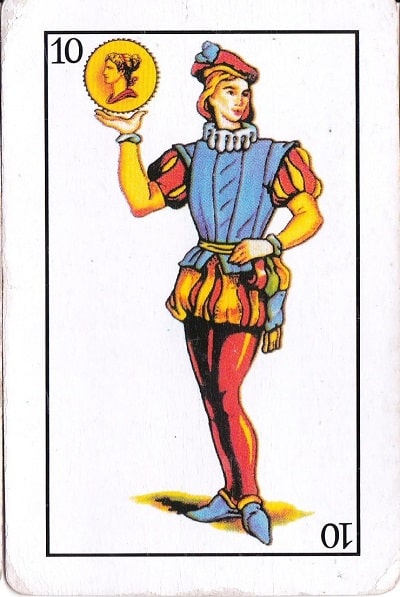
The origin of Joto could exist in Sota de Oros, carte du jour of the Spanish Deck. Fragment of "Cartas del juego Tute" By Tupeorpesadilla.com718 – Own work, CC Past-SA 3.0
Variants: Jotito, Jota.
Run into: Forty-One
+
Julai
Julai is a term used confronting gay men with the top sexual part in anal intercourse or in full general for homosexual men. Probably related to that this expression as well had the meaning of stupid, imbecile, unwary, despicable man or victim of theft or fraud. As on other occasions, to homosexual human being is supposed all sorts of defects and so information technology is possible that in that location has been a semantic spring and has ended up being used as derogative slang for gay people, equally happens for example with the word Duck.
Variations: Jula, Julay, Julandra, Julandras, Julandrón.
Related: Pato.
Read more: Pato. Gay Dictionary: (Latin America).
+
K'ewsa
K'ewsa is a term of Quechua / Aymara origin used in Bolivia today with the pejorative pregnant of homosexual or effeminate man, although we have establish translated as a coward, coward who beats women, chueco (twisted) and other items that indicate inappropriate behavior.
It is a term that has go the center of the argue on homosexual behavior in pre-Columbian societies, between those who argue that homosexuality is imported and therefore deny that the give-and-take meant something like "homosexual" in origin, and those who meet in the being of this term, a clear evidence to the contrary.
Beyond the absurd and outdated that it seems the debate, the first reference nosotros have plant is from 1612, in which the term Yard'ewsa or K'iwsa is related to homosexual behavior. In the vocabulary of the Aymara Language of Ludovico Bertonio, Thou'iwsa is translated every bit "patient in the nefarious sin" that is, who is fucked, the bottom in anal intercourse, and Yard'iwsa Jucha, as nefarious sin (sodomy), being the term jucha the Aymara term for sin.
2
Loca
Loca is a Spanish term widely used, even within the LGBT community, to refer to a very effeminate homosexual human being.
On the origin of this expression, nosotros can comment on a couple of hypotheses that complement each other.
In this expression, we detect the phenomenon that we accept talked about on many occasions: that of transferring to masculine homosexuality, a slang used previously for female prostitution, as is the case with the discussion gay. Loca also has/had the meaning of "mujer alegre" (happy woman), prostitute, etc.
On the other hand, loca, and its masculine class, loco, are words widely used in Castilian to refer to a person with a mental affliction, but as homosexuality was considered in the pathologizing era.
Variations: Locaza, Loquita, Locaza desatada, Loquero (Venezuela), Loquísima (Cuba), Loca de atar (Peru), Loca desbaratada (Republic of colombia), Loca desplumada (Cuba), Loca fuerte (Miami, Chile), Loca sucia (Miami, Rep. Dominicana, El salvador, Honduras, Peru, Puerto Rico, Venezuela), Loca desmetecada (Mexico).
Related: Reina
Read more than: Khing. Gay Lexicon (Thailand).
+
Macha
feminine for Macho. Macho is a Castilian expression with several meanings. I of them is to name a typical male, a manly human, etc. So Macha is an expression of 70's, belonging to the gay slang, to ironically refer to homosexual homo who boasts of excessively virile attitudes, or during sex, takes a role of straight man ("suck my cock, give me your donkey, nothing more").
+
Mamona
That sucks, that chest, referring to fellatio. Expresed in feminine by patriarchal feminization to gay men.
Related Cocksucker.
+
Marica
Its translation into the English language would be a fag. Marica is one of the almost commonly used terms for insulting the gay man, with its variations maricón and mariquita. Has its origins in the name of a woman, María, being its pet or family version. It is related to male person homosexuality past twofold.
The showtime comes from the 15th century in which Marica was slang of like shooting fish in a barrel or libidinous woman, this is tart, floozy or prostitute. The relationship established between male homosexuality and prostitution as well occurs in other languages, such as English, in which many terms like "gay" or "faggot" earlier used to insult gay men were used to insult women or refer prostitutes.
The second comes from the 17th century when is used to insult the effeminate human being because calling him as a woman, his fiddling masculinity highlights.
Later, it will be used to insult the gay man, and more than specifically to bottoms or with the passive role in anal intercourse, equating to women for sharing the same sexual office. Is interesting to note the existing misogyny behind that discussion, because it highlights the negativity involved femininity, both women, considered submissive and passive, equally for gay men who are considered every bit women. Behind homophobia is hiding adulthood.
Marica is besides the name given to a blazon of magpie, Urraca in the Castilian language, being Urraca likewise a proper noun of the adult female. The term Marica today is also widely used in the LGBT scene replacing the discussion gay.

T-shirt with the Marica drawing. Yous can buy it in our online stores.
Variations: Mariquita, Maricón, Marieta, Mariquitilla, Mariíca, Mariconada, Mariconazo, Maricona, Mariconcete, Marimarica, Maruso, Marusa, Marico (Venezuela), Maricona dramática (Colombia, Miami, Honduras, Mexico, Puerto Rico), Mariquilla (Bolivia), Mariquito (Miami, Ecuador, El Salvador, Mexico, Perú, Puerto Rico, Venezuela).
Read more: Marica. Gay Dictionary (Spain).
4
Maricón

The give-and-take Maricón is augmentative of Marica, which is also a kind of magpie.
We could translate the Spanish word Maricón into the English language term faggot. Information technology is an expression that appeared in the 16th century, and it seems to refer more to the homosexual man with an mental attitude and masculine appearance, although throughout the centuries, its awarding has been changing. Beingness augmentative for Marica, the negative connotation is college than in the terms Marica and Mariquita, a fact that draws attention due to the profound contempt for femininity that existed at the time, as we have already explained in this dictionary in the entry Marica.
It was non just used against homosexual men merely as well used every bit an insult for men who did non exercise domination and violence confronting women and to insult any man. Despite the manly nuance of the term, the Maricón became popular by becoming an archetype of the theater of the Spanish Golden Historic period, being the mannered and feminine aesthetics grapheme to tease of, and to have fun at his expense and with which, therefore, should exist avoided any comparing. For this reason, often appear in expressions like "te van a tomar por maricón" (they will see you as faggot).
Since the Spanish dictatorship Maricón besides was used, to a greater extent, to refer to homosexual men with masculine attitude, and this greater invisibility was precisely that makes the Maricón had less social acceptance that the Mariquita, more feminine, with whom make fun (including sex) and therefore less dangerous. In this sense, the maricón angry fear among heterosexual men because they had their same gender expression (not feminine) and, were supposed agile (top) in sex, and also for beingness socially linked with pederasty.
Today, the term Maricón no longer has the hue of masculinity and, its utilise is general for any gay, to insult any heterosexual homo and, even to name amicably between friends, either gay or straight.
Variants: Mariquita, Marica, Marieta, Mariquitilla, Mariíca, Mariconada, Mariconez, Mariconazo, Maricona, Mariconcete, Marimarica, Maruso, Marusa, Marico (Venezuela), Maricona dramática (Republic of colombia, Miami, Republic of honduras, Mexico, Puerto Rico), Mariquilla (Republic of bolivia), Mariquito (Miami, Republic of ecuador, Republic of el salvador, Mexico, Perú, Puerto Rico, Venezuela).
Read more than: Marica. Gay Dictionary (Spain)
+
Mariposón
augmentative for Mariposa (Butterfly) used euphemistically to refer to homosexual or effeminate man. This term highlights stereotypical characteristics of gay men, such as exhibitionism, mannered, the colour of article of clothing, besides equally promiscuity or little continuance in love because they waltz from flower to bloom.
Curiously, the first written reference of butterfly related to male homosexuality is the 16th century, done past Pedro de León, Jesuit confessor to the prison of Seville, in the book "El apéndice de los ajusticiados" (Appendix of executed). Pedro de León compared the men who adept sodomy with the "mariposillas" (little butterflys), that tempted by the lite of the flame get likewise close and ended up burning, every bit well information technology happens to the sodomites, who but burned at the pale.
Variations Mariposa, mariposilla.
+
Mariquita
Could exist translated into the English language as a sissy, pansy. Initially, both Marica as Mariquita were pet forms for the name María (Mary). Thus this term is recorded in the DRAE of 1869 as atomic of María, and in 1884 as atomic of Marica. Information technology is not until 1925 when it is included for the starting time time the pregnant of effeminate homo. Despite used interchangeably, it seems that the difference between Mariquita and Maricón is the degree of effeminacy of the person against whom it is used. Although currently the DRAE retains the meaning of effeminate homo and does not include the pregnant of insult to homosexual men, it is a fairly common insult used confronting any man, gay or not, effeminate or non, and even as an affectionate joke between macho-man friends.
Information technology is also the proper noun given to the pop insect, the ladybug.

T-shirt with the Mariquita drawing. Y'all can purchase it in our online stores.
Variations: Marica, Maricón, Marieta, Mariquitilla, Mariíca, Mariconada, Mariconazo, Maricona, Mariconcete, Marimarica, Maruso, Marusa, Marico (Venezuela), Maricona dramática (Colombia, Miami, Honduras, United mexican states, Puerto Rico), Mariquilla (Republic of bolivia), Mariquito (Miami, Republic of ecuador, El Salvador, Mexico, Republic of peru, Puerto Rico, Venezuela).
Read more: Mariquita. Gay Lexicon (Kingdom of spain).
+
Mayate

We dear the Practise not kill the mayate! Please, delight!
Picture by CC News
Mayate is a term that has its origin in the word mayatl, from the Mexican Nahuatl language, used to denominate a beetle. People besides use it to insult homosexual men, although more specifically, to proper name those men who define themselves as heterosexual, but who accept sex activity with men. Mayate would be the equivalent of the Peruvian Mostacero and the Colombian Cucarrón. In both cases, the exclusively top role of these men in anal intercourse is highlighted by the remainder of the feces that the penis tin can show after anal sexual practice.
In Mayate, the relationship with feces may be that the larvae of this beetle feed on other animal feces, as is the instance with the term Cucarrón, which is a beetle that is dedicated to send assurance of excrement from side to side to feed himself. There are those who affirm that the relationship with the beetle is that it makes perforations (penetrations) in the cornfields, even that it has to do with the bright colors of the insect in relation to the bright and strident colors of homosexual men, a relationship that we discard since this slang is conspicuously used to refer to masculine men.
The first written reference nosotros take found of the word mayate related to homosexuality is found in 1904 in a text by Carlos Roumagnac "Criminals in Mexico: essay of criminal psychology" which talks virtually mayates and horses as slang expressions of the prison surroundings, existence Mayate the men who perform the elevation role and the horses the men who played the lesser role. Bearing in mind the ability of "heterosexual" men to have sex with other men in the absence of women, we detect in this origin the markedly masculine and superlative role of the word mayate that has come present.
It should be noted that in the Pachuco's Caló jargon, young people of Mexican origin residing in the southern United States, mayate is used to disparagingly refer to African-American men. Another significant we have institute of the slang mayate is that of a drunk. And you only need to stroll nigh Twitter to realize that today, Mayate, Chacal, and Mostacero are anyone.
Synonyms: Mostacero, Cucarrón. See: Mostacero. Gay Dictionary (Republic of peru)
+
Mondrigón
term used in Western Andalusia, especially in Cadiz (Spain), to bespeak to homosexual man. It seems to have originated by phonetic similarity to the term Maricón (faggot), and that could have been used as a euphemism, for example, in the couplets of Chirigotas of the carnivals in the area, motivated by can not use the word really meant. Thus, had passed to popular speech also as a euphemism, and finally would have acquired a very debasing and derogatory nuance, as nosotros have read in several pages, because means the worst of the worst.
Variations Mondri.
+
Mostacero
The Mostacero is a heterosexual man and beyond, is the male, rough looking, virile, manual worker, sailor, soldier, welder, agro-man, etc, who gets horny with the butt of the apprentice. We tin complete the profile with the essence of patriarchy: male chauvinism, sexism, homophobia, xenophobia, etc. This blazon of man also is in groovy demand among fags seeking "real real men". The origin of this slang expression, as well as its synonyms, is quite scatological, read our Gay Slang Series post to learn more about this slang and about this curious masculine behavior.

T-shirt with the Mostacero cartoon. You tin can purchase it in our online stores.
Synonyms: Chacal, Cucarrón, Mayate
Read more: Mostacero. Gay Dictionary (Peru).
Read too: Homosexual beliefs and homosexuality in our web log.
+
Muerde Almohadas
pillow biter. Is a graphical expression of one of the positions for anal sex, who is penetrated bites the pillow, supposedly to endure the pain, and also refers to the different social perception that historically has been attributed to person who is penetrated different from who penetrates. Derogatory.
Related Sopla nucas (napes blower)
+
Musculoca
Term used among gays to describe a very effeminate man with not bad muscular development. The word is composed past two parts Musculo+loca, significant musculus+madwoman.
+
Nenaza
Nenaza is the augmentative of Nena, which is a colloquialism to refer to a young daughter or a woman affectionately. It used against the effeminate or homosexual homo, want to insult highlighting the lack of manliness in two ways, with childhood (unfinished man) and with femininity.
Related: Moña.
+
Palabrimujer
as it happens with the lack of hardness in features or lack of facial or body pilus, gender vigilance likewise occurs with the tone of voice, as loftier-pitched tone is related to women. Palabrimujer is one of the expressions, which appears in the DRAE every bit a synonym for homosexual or effeminate man.
Related eunuch.
3
Palomo
Pigeon. Although the term is best known for the idiom "más maricón que un palomo cojo", this expression is slang for a homosexual or effeminate man, and Palomar (dovecote) was the name given to the place of prisons destined to homosexuals. There are several hypotheses for the origin or reason of the slang, that are complementary. The term Palomo is besides slang for a fool or simple man, negative characteristics of men that, as on other occasions, are attributed to gays past the simple fact of existence. Examples of this are the terms Pato and Julai. On the other hand, this term too has the meaning of a quiet and balmy person, features that practise non see the male stereotype. And finally, we accept the traditional association established between birds, feathers and sure insects with male homosexuality.
Related: Pato, Julai.
See: Palomo Cojo. Gay Dictionary (Spain)
+
Palomo Cojo
Translated into English language as lame pigeon is, with tortillera, 1 of the most searched LGBT expressions on the Net. Is an expression that has starred in books, films, festivals, radio debates, social networks, and linguistic communication specialized forums. It'due south often used in the idiom "Es más maricón que un palomo cojo" (He is more faggot than a lame pigeon), that gives us the clue near the origin of the expression. Apparently, the upshot is that the poor lame pigeons can't reproduce because they need 2 legs to tread (mount) the dove, with only one leg cannot hold up on the dove nor perform the feature prior courtship of the species. However, the sexual life of pigeons is more complex than this. Cheque out our Gay Slang Serial post for more details.
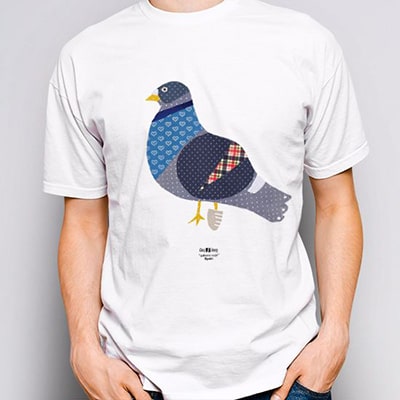
T-shirt with the Palomo Cojo cartoon. You can purchase it in our online stores.
Read more than:Palomo Cojo. Gay Lexicon (Spain).
+
Parcha
term used in Venezuela to refer disparagingly to homosexual man. Parcha is the name given to the passion fruit. In relation to male homosexuality we discover the maxim "sembramos mango y salió parchita" (we planted mango and grew up passion fruit).
Variations Parchita (diminutive for Parcha).
+
Pato
A term used in Mexico, Nicaragua, Panama, Peru, Puerto Rico, Venezuela, and Cuba to insult gay men. As in other terms, to explain the origin of this use of the word alludes to gait duck or more than eschatological brute issues. However, the explanation is much simpler: duck is a give-and-take with several meanings, basically two. In add-on to the fauna, duck also means a clumsy person, without grace, that not learns, dumb and teased, and as happens in and then many insults, the negative characteristics of some men are transferred to homosexual men simply considering they are so. Y'all can find more information in our Gay Slang Series mail service.

The Pato cartoon printed on a white t-shirt. You lot tin can buy it in our online stores.
Read more: Pato. Gay Dictionary (Latin America).
+
Pederasta
pederast. In ancient Hellenic republic, the pederast was the developed human who maintained a consensual concrete relationship with a teenage boy in a ritual of conventions, socially accustomed, that constitute the system of homosexual relationship instructor-pupil. After the rediscovery of classical culture with medieval eyes, the word pederast begins to acquire negative nuances.
The term pederast is recovered in the 19th century such as shown in the Dictionary of the Royal Academy of the Spanish Language (DRAE) from 1899 with the pregnant of "who commits sexual abuse confronting children". In this manner, the nuances that separate Greek pederasty and platonic love of crime and corruption, are eliminated. Popularly, homosexuality with Greek pederasty is related, and then too, in this 1899 edition, the DRAE includes sodomite (who commits sodomy) as meaning of pederast, and defines sodomy as "concúbito between same sex, or against the natural society", to add in 2001 "practice of anal intercourse ". In this way the criminalization of homosexual was reinforced, because co-ordinate to the dictionary, a pederast is a sodomite and sodomite is a homosexual. Fortunately, the 23th edition of the DRAE no longer sets with their definitions the link between the criminal pederast and homosexual man, important issue if nosotros consider that in many countries the word pederast, whatever variant and whatever word that sounds phonetically like, are used to insult and criminalize homosexual men.
+
Pierde Aceite
Literaly leaks oil. Is a euphemism to say that someone is homosexual. Some say it refers to the "consequences" of anal sex, just more likely it is for the sense of spoiled, damaged or defective.
+
Plumera
plumera is the feminine grade for plumero, which translated to English language is a feather duster, or annihilation with feathers. The term was used in Spain in the 70s, belonging to the gay jargon to refer to homosexual homo who "has feather" or "spent feather", way to limited that someone is effeminate.
According Cardín someone could be Plumera past excess, so effeminate that approach to transgender, or by default, in cases of cripto-homosexuals (homosexuals in the closet) showing gestures, attitudes or expressions that denote femininity and betray them.
According to Cela, feather also means prostitute, loose woman and fifty-fifty penis.
In any example, the relationship established among birds, female prostitution and male homosexuality has led to a multitude of words and expressions in many languages, every bit Palomo, Palomo Cojo and Marica in the instance of Castilian language, Petuh in the case of Russian and Feygele in Yiddish.
Variations Plumífero, Plumero (Venezuela), Plumoso (Republic of colombia).
+
Plumífero
Pluma translated to English language is feather. Plumifero refers to having feathers. Term used in Puerto Rico. We do non know if it refers to the term Pato, creature with feathers, or refers to the expresion "Tener pluma" (to have feather) used to indicate effeminate or military camp men.
Variations Plumera, Plumero (Venezuela), Plumoso (Republic of colombia).
Encounter Gay Dictionary: Pato (Latin America)
+
Portaviones
aircraft carrier. Gay jargon term used in Spain in the 70s and 80s, to refer disparagingly to very old homosexual men that, according to the glossary of Cardin, are still agile. We understand withal active every bit, to go out in gay scene, flirting, cruising, etc. It is proposed as a synonym for Carroza and, information technology may be, given the size of aircraft carriers, equally pinnacle.
Related Carroza, Chapero.
+
Puñal
Puñal, translated to English language is dagger, is a term used in Mexico to bespeak gay men.
Variations Puñalín (diminutive for puñal), Puñalón (augmentative for puñal).
+
Puto
Means male prostitute. Widely used in Kingdom of spain during the Middle Ages relating gay people with prostitution, was later replaced by the discussion "Maricón" (faggot). Currently widespread in Latin America, equally shows the unfortunate example of the song "Puto" of the Mexican band, Molotov. Derogatory.
+
Rarito
atomic form for Raro, meaning weird, crank, etc. Depending on the context, may be a euphemism for a homosexual man.
Variaciones Raro.
+
Reina
term used to describe an effeminate gay man, haughty and contemptuous, which is inappreciably accessible both in manner and for sex
Variations Reinona
Related Loca
Run intoGay Lexicon: Khing (Thailand)
+
Rosquete
derived from the word Rosquilla, meaning doughnut, fried ring-shaped block, Rosquete is bigger than Rosquilla. The relationship with male homosexuality comes from the pigsty of the cake related to the anus. Rosquete is used in Republic of peru to point homosexual men.
+
Sarasa
Means sissy. It comes from the patriarchal identification homosexual = prostitute, because Sarasa means pest, woman of ill repute. Derogatory.
Related Puto
+
Serie
Serie or too "D Series", are expressions used in the 70s and 80s to name homosexual or effeminate man, that appear in Martin and Leon dictionaries of slang, but nosotros could non detect an explanation of the origin or motives. The relation with homosexuality could be an upshot of quality, as A series could be better than D series, because homosexuality every bit something defective. Nosotros take as well constitute "B Series" which reminds us of the expression of Finnish language B-Rapun Poika or boy of B stairs.
+
Sodomita
Sodomita was, initially, the name given to the people living in Sodom, the mythical city of Palestine, that according to the Bible, was destroyed by the divine burn considering of the lack of hospitality of its inhabitants. All the same, every bit we explained in our blog commodity "Word of God", the word sodomita was changing it meaning with the successive and biased translations of the Bible.
Offset, the give-and-take sodomita was used to condemn whatever sexual practice that had no reproductive purposes, but with successive translations of the Bible, finally used to condemn only anal sexual practice betwixt men. However, in the beginning, the word sodomita was not used primarily to describe the person but was used to a greater extent to condemn their deportment, ie sodomy, which in many texts also included sex with animals.
The showtime reference of the word sodomita appears in 1254 on a text by Alfonso X entitled "Judizios de las estrellas" and besides appears in some regional code of laws of the 14th century, past its condition of beingness an insult that must to be avoided, with its variations like "sodomético", "sodómico", "sodomista", "sodomítico", "sodomitoso", "solomico" and "somético".
It is in this medieval times when sodomy becomes a offense severely punished by the Inquisition and in the great sin amongst sins, which until the 17th century was reducing its scope of application to finally mean anal sex between men.
Thus the DRAE, in 1739, defines sodomy as "concúbito between persons of the same sex or improper glass" and in 1854, "against the natural order."
In the 19th century, the Napoleonic Code decriminalizes sodomy to understand information technology every bit a private only repulsive human action, and this legal alter has resulted in the inclusion in the DRAE in 1884 as a definition of sodomita "native of the metropolis of Sodom; belonging to the city of Palestine".
The last change in the DRAE about the meaning of sodomita has occurred recently, changing "committing sodomy" past "practicing sodomy".
The word sodomita among of being used equally an insult and religious and legal texts has been used too in medicine, natural sciences, and anthropology. Today it is near obsolete.

I Survived Sodom drawing printed on a t-shirt. You tin purchase information technology in our online stores.
Read more: I Survived Sodom and I Love Sodom from Funny and Protest collections.
Read also: The word of god. Post from our blog.
+
Tabla
its literal translation to English language is plank, board, etc. Term of the 70s and 80s used in Espana, to point to homosexual man, that appears in Martin and Leon dictionaries of slang. We accept not found any caption about its relation with gay men.
+
Tomante
from the verb Tomar (to take), the Tomante is the person who takes, who receives. Information technology is a term used to name gay people with passive (bottom) part in anal intercourse, that is, who is fucked.
Related Dante.
+
Trolo
Trolo is a slang term created in Argentine republic which is used to insult gays. Its nearly likely origin is the masculinization of the slang trola, term used to insult "easy women" and also to refer to prostitutes. This is the same process used by words such as puto and gay, whose origin as slang for homosexual men is in the prostitution of women. This would exist the most bones caption because an Argentinian author told us that people don't use trolo in itself. In order for it to be insulting, it must be used along with some complement such as trolo de mierda.
At present we are going to talk about which is non the origin of trolo, despite it being the about widespread version on the web (fifty-fifty in Instituto Cervantes). According to this version, trolo would have its origin in the trolleybus, a means of urban transportation inaugurated in Argentina in 1913. Why? Because the people accessed the trolley bus from backside, in a articulate reference to anal intercourse. The investigation of this slang is not finished nonetheless because we demand dates and references. However, intuition tells us that this origin is one more of the simplistic and morbid explanations given to words refering to gay and lesbian people, the clearest example of this being the word tortillera.
Run into: Trola. Lesbian Dictionary: Spain.
+
Trucha
This Spanish give-and-take, translated to the English language every bit Trout, as well the name of the fish, is a slang term with a large multifariousness of meanings depending on the time and place to consider. This is why trying to find out the origin of Trucha every bit a slang term for homosexual human, faggot, etc., is tremendously complicated and glace, as is the fish, especially in this case, where several explanations seem reasonable. Even compared to other slang expressions, as we do many times, the result is not conclusive. Do not miss our Gay Slang Series mail if you want more information virtually this discussion, its possible meanings and some interesting facts.

The Trucha cartoon printed on a t-shirt. You tin purchase it in our online stores.
Read more than: Trucha. Gay Dictionary (Spain).
+
Vaquerobia
gay slang expression used in Mexico to refer to gay men with cowboy hat. It comes from the term Obvia (obvious) used to refer to effeminate homosexual.
Variations Vaquerobvia.
+
Vena
streak (personality trait). Term used in Western Andalusia, peculiarly in Cadiz (Spain), to point to homosexual homo. As the term Venazo, it is used to describe a congenital, intimate and non-obvious characteristic of a person, which at a given moment gains protagonism, equally for case "tiene vena de emprendedor" (he has entrepreneur streak) or "cuando baila le sale la vena marica" (when he dance comes out his fag streak). Following this terminal example, the origin of the slang would exist the change from "vena marica" (fag streak" to "vena" (streak) metonymy quite common in slang.
Variations Venazo (augmentative for Vena).
Source: https://www.moscasdecolores.com/en/gay-dictionary/spanish
0 Response to "How To Say A Man In Spanish"
Post a Comment